Speed Limits in Poland 2026 – Table of Limits, Fines and Penalty Points
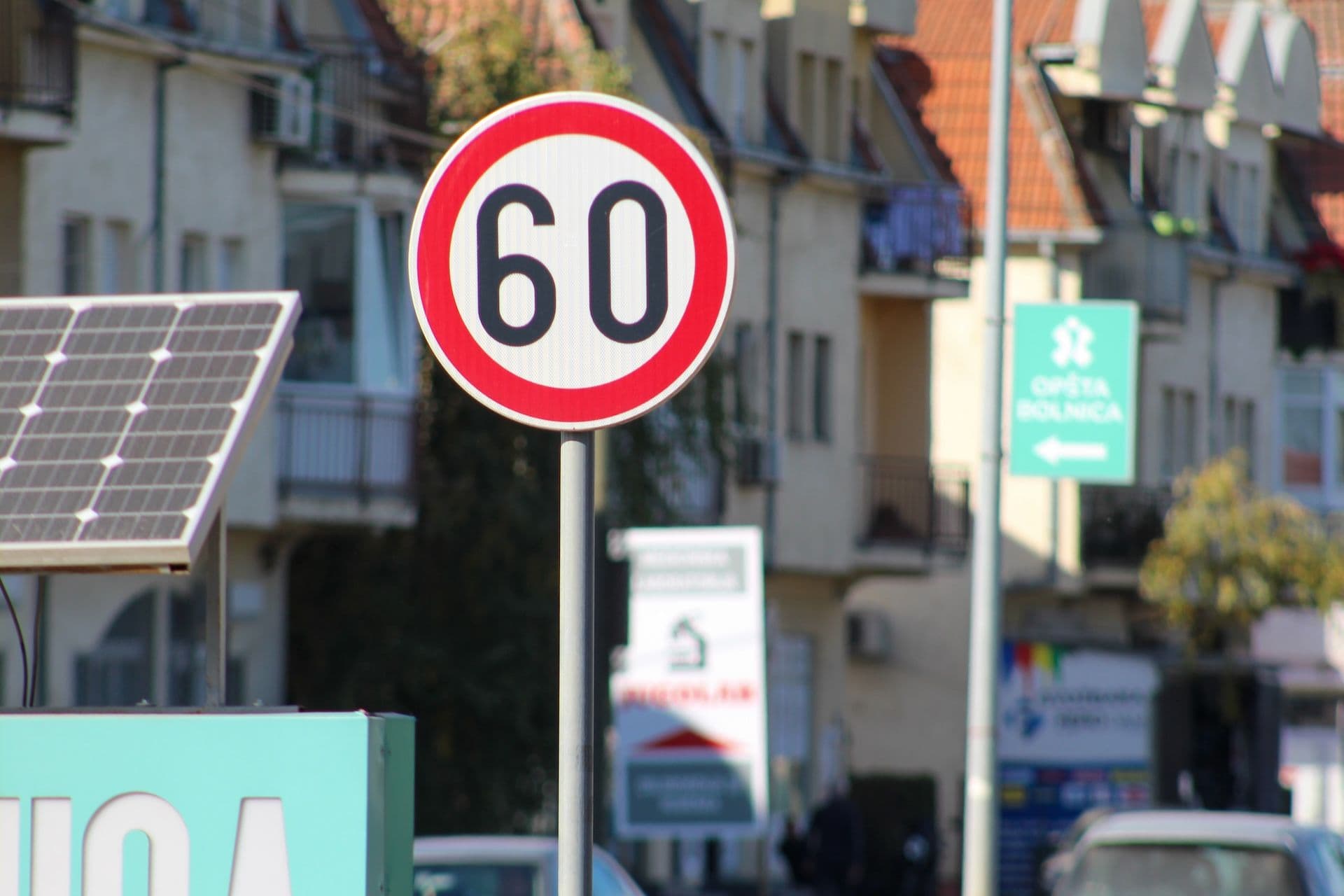
Speed limits in Poland depend on the type of road, the time of day and the type of vehicle. The highest permitted speed is 140 km/h on motorways, while in built-up areas the limit during the day is 50 km/h. On 3 March 2026, the rules on suspending driving licences for speeding outside towns also changed. Below you will find a complete table of limits, the amounts of fines and penalty points, and practical tips for drivers – including those travelling around Poland in a rental car.
The limits below apply to passenger cars, motorcycles and goods vehicles with a maximum permissible weight of up to 3.5 t. They apply whenever road signs do not indicate a different speed.
| Type of road | Speed limit |
|---|---|
| Residential zone | 20 km/h |
| Built-up area, 5:00–23:00 | 50 km/h |
| Built-up area, 23:00–5:00 | 60 km/h |
| Single-carriageway road outside built-up areas | 90 km/h |
| Dual carriageway (at least 2 lanes in each direction) outside built-up areas | 100 km/h |
| Single-carriageway expressway | 100 km/h |
| Dual-carriageway expressway | 120 km/h |
| Motorway | 140 km/h |
A built-up area begins after sign D-42 (a white sign with the silhouettes of buildings) and ends after sign D-43. The limit is 50 km/h during the day and 60 km/h at night, from 23:00 to 5:00. If a plate showing a different speed is placed under sign D-42, that speed applies throughout the built-up area, regardless of the time of day.
In a residential zone (sign D-40), the maximum speed is 20 km/h, and pedestrians have priority over vehicles. We describe the rules for driving on such roads in detail in our article internal roads, traffic zones and residential zones.
On a dual-carriageway expressway (two carriageways separated by a central reservation), the limit is 120 km/h. On a single-carriageway expressway, with one carriageway and traffic in both directions, the maximum is 100 km/h. Expressways are marked with sign S-3, showing a white car on a blue background.
On a motorway, you can drive a passenger car at a maximum of 140 km/h. This is one of the highest limits in Europe, but lower limits indicated by signs often apply on sections with roadworks, near junctions and on city bypasses. There is also a minimum speed on motorways: vehicles whose design does not allow them to travel at least 40 km/h are not allowed on them. If you are wondering how to use motorway lanes correctly, read our article can you drive in the left lane all the time.
| Vehicle | Built-up area | Outside built-up areas | Expressway / motorway |
|---|---|---|---|
| Passenger car with a trailer | 50 / 60 km/h | 70 km/h | 80 km/h |
| Goods vehicle over 3.5 t maximum permissible weight | 50 / 60 km/h | 70 km/h | 80 km/h |
| Goods vehicle (delivery van) up to 3.5 t maximum permissible weight | 50 / 60 km/h | 90–100 km/h | 120 / 140 km/h |
Delivery vans and passenger minibuses up to 3.5 t have the same limits as passenger cars. You can read more about when a minibus counts as a passenger car and when it is a truck in our article is a minibus a passenger car or a truck in Poland.
For the first 8 months after obtaining a category B licence (the standard Polish car licence), drivers must not exceed 50 km/h in built-up areas, 80 km/h outside them and 100 km/h on motorways and expressways.
The amount of the fine and the number of penalty points depend on how many kilometres per hour over the limit you were driving.
| Speed over the limit | Fine | Penalty points |
|---|---|---|
| up to 10 km/h | PLN 50 | 1 |
| 11–15 km/h | PLN 100 | 2 |
| 16–20 km/h | PLN 200 | 3 |
| 21–25 km/h | PLN 300 | 5 |
| 26–30 km/h | PLN 400 | 7 |
| 31–40 km/h | PLN 800 | 9 |
| 41–50 km/h | PLN 1,000 | 11 |
| 51–60 km/h | PLN 1,500 | 13 |
| 61–70 km/h | PLN 2,000 | 14 |
| over 70 km/h | PLN 2,500 | 15 |
Repeat offences: if you exceed the speed limit by more than 30 km/h again within two years, the fine is doubled. Exceeding the limit by 31–40 km/h will then cost you PLN 1,600, and exceeding it by more than 70 km/h as much as PLN 5,000. You will find the full list of penalties in the 2026 Polish traffic fines tariff (taryfikator mandatów 2026).
If you exceed the speed limit by more than 50 km/h, the police will suspend your driving licence for 3 months. Until recently, this penalty applied only in built-up areas. Since 3 March 2026, it has also applied outside built-up areas on two-way single-carriageway roads, including single-carriageway expressways. In practice, this means you will lose your licence if you:
The rule does not cover motorways or dual-carriageway expressways. If a driver drives a vehicle while their licence is suspended, the suspension is extended to 6 months, and for a further such offence the licence is revoked.
Speed is measured by fixed speed cameras, average speed camera systems, handheld police speed guns and police cars fitted with video recorders. More and more new devices take photos of vehicles from both the front and the rear. You can read more about this in our article do speed cameras take pictures from behind.
The renter – that is, the person driving the car at the time – is responsible for traffic offences committed in a rental car. When a speed camera records a speeding offence, the notice is sent to the vehicle's owner, which is the rental company. The rental company then identifies the renter on the basis of the rental agreement, and the notice and fine go directly to them. We describe the rules of liability for a rental car in our article liability for a rental car.
If you are driving around Poland in a rental car, use a sat nav that shows the current speed limit. Newer models in the MobiCars fleet have cruise control and driver assistance systems that make it easier to stay within the law. We explain how these systems work in our article how ADAS systems work in a modern car.
Planning a road trip abroad? Limits vary from country to country, and fines can be many times higher than in Poland.
| Country | Built-up area | Outside built-up areas | Motorway |
|---|---|---|---|
| Poland | 50 km/h | 90 km/h | 140 km/h |
| Germany | 50 km/h | 100 km/h | 130 km/h recommended |
| Czechia | 50 km/h | 90 km/h | 130 km/h |
| Slovakia | 50 km/h | 90 km/h | 130 km/h |
| Austria | 50 km/h | 100 km/h | 130 km/h |
| Croatia | 50 km/h | 90 km/h | 130 km/h |
| Italy | 50 km/h | 90 km/h | 130 km/h |
If you are going abroad in a rental car, read our guide on taking a rental car abroad.
In built-up areas, the limit is 50 km/h from 5:00 to 23:00 and 60 km/h from 23:00 to 5:00, unless signs indicate otherwise.
On a dual-carriageway expressway, the limit is 120 km/h, and on a single-carriageway expressway it is 100 km/h.
In a passenger car, you can drive on a motorway at a maximum of 140 km/h. Cars with trailers and goods vehicles over 3.5 t maximum permissible weight can drive at no more than 80 km/h.
On an ordinary single-carriageway road outside built-up areas, the limit is 90 km/h, and on a dual carriageway with at least two lanes in each direction it is 100 km/h.
For exceeding the speed limit by more than 50 km/h in built-up areas and, since 3 March 2026, on two-way single-carriageway roads outside built-up areas. Your driving licence is then suspended for 3 months.
For exceeding the speed limit by 16–20 km/h, the fine is PLN 200 and 3 penalty points.
Related articles: