Black ice – how to drive safely and what to do in a skid on ice
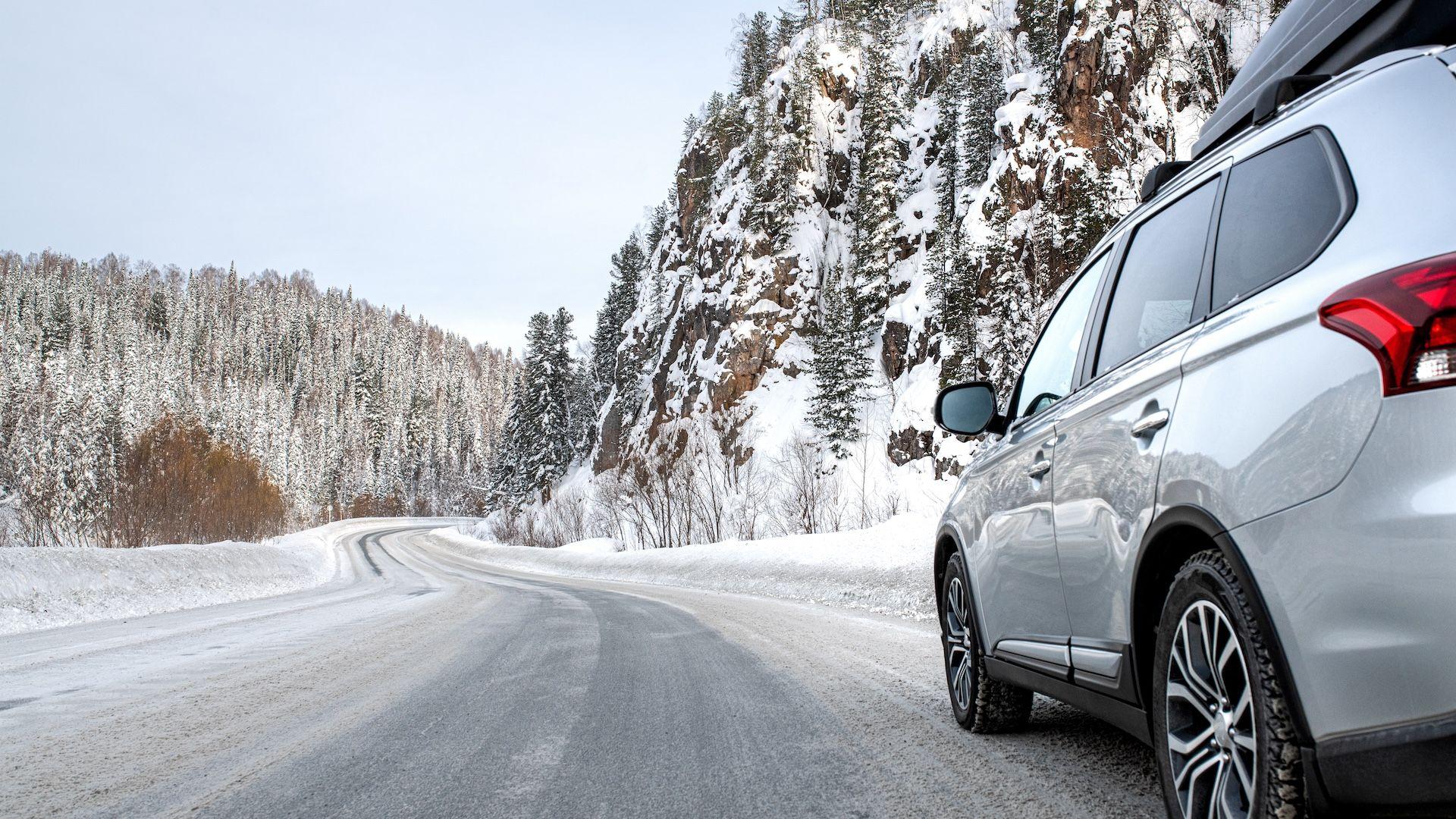
Black ice is one of the most dangerous things a driver can face in winter. The thin layer of ice is almost invisible – the road simply looks wet – yet tyre grip drops to a fraction of what it is on a dry surface. This guide explains what black ice is (and how it differs from frost and refrozen roads), when it forms, how to recognise it, how to brake with ABS and what to do in a skid on ice, whether the car understeers or oversteers.
In everyday language, any icy road is called black ice, but meteorologists distinguish between several phenomena. Polish weather forecasts use specific terms, so it helps to know them if you drive in Poland.
For the driver the effect is similar, but glaze can appear suddenly, mid-journey, on a road that was just wet a moment earlier.
Most often when the air temperature is around 0°C and a layer of warmer air sits above cold air near the ground. Rain falls through the cold layer, becomes supercooled and freezes only when it touches the road. That is why the car thermometer can show +1°C while the road is already covered with ice – the ground and asphalt are often colder than the air.
Places to be especially careful:
You cannot always see it, which is why it is called “black” ice. There are, however, warning signs:
If in doubt and nobody is behind you, brake gently at low speed on a straight stretch. If ABS kicks in immediately, grip is minimal.
Poland’s national weather service, IMGW-PIB (Institute of Meteorology and Water Management), issues warnings worth checking before every winter trip – on its website and app; in more serious situations the government also sends RCB alerts by text message to phones in the affected area:
With a level 2 or 3 freezing precipitation warning, the most sensible option is to postpone your journey if you can.
The same rules apply if you are wondering how to drive in snow – except that compacted snow usually offers noticeably more grip than ice.
Braking distance depends on speed and the friction between tyre and road surface. Typical friction coefficients are around 0.7–0.9 for dry asphalt and about 0.1 for ice – even lower for wet ice. The UK Highway Code warns that in icy conditions braking distances can be up to ten times longer than on a dry road.
Below are approximate calculations of braking distance alone (excluding reaction time), using simplified, typical friction values:
| Speed | Dry asphalt (approx. 0.8) | Wet asphalt (approx. 0.5) | Compacted snow (approx. 0.3) | Ice (approx. 0.1) |
|---|---|---|---|---|
| 30 km/h | approx. 4 m | approx. 7 m | approx. 12 m | approx. 35 m |
| 50 km/h | approx. 12 m | approx. 20 m | approx. 33 m | approx. 100 m |
| 70 km/h | approx. 24 m | approx. 39 m | approx. 64 m | approx. 190 m |
| 90 km/h | approx. 40 m | approx. 64 m | approx. 106 m | approx. 320 m |
These are estimates – real figures depend on the tyres and their temperature, vehicle weight, the type of ice and the condition of the brakes. You also need to add the distance covered during your reaction time: at 50 km/h that is about 14 m for every second. In short, on black ice at 50 km/h a car may need more than 100 metres to stop.
Most modern cars have ABS, which stops the wheels from locking and lets you steer while braking. On ice, remember three things:
In a car without ABS, use cadence braking: press the brake to the point just before the wheels lock, release slightly and repeat. You will find more about how the system works in our article ABS – what is it?
The key rule for every skid: look where you want to go, not at the obstacle. Your hands follow your eyes.
Understeer happens when the front wheels lose grip and the car turns less than the steering wheel indicates, running wide in a bend. It is most common in front-wheel-drive cars, especially when entering a bend too fast or accelerating mid-corner.
Oversteer means the rear axle loses grip: the back of the car swings towards the outside of the bend and the car starts to rotate. It is typical of rear-wheel-drive cars under power, but on ice it also happens in front-wheel-drive cars – for example after suddenly lifting off the accelerator or braking in a bend.
Similar reflexes help when skidding on a wet road – we explain losing grip on a layer of water in what aquaplaning is and how to avoid it.
If you rent a car in winter, take a few minutes to get to know it before setting off: check how the winter mode works (if there is one), where the window heating controls are and which wheels the car drives. In the winter season MobiCars cars run on winter tyres or high-quality all-season tyres. Even so, when IMGW warns of freezing precipitation, calm driving – or postponing the trip – remains the best strategy.
Black ice is a thin, smooth and usually transparent layer of ice that forms when supercooled raindrops or drizzle freeze on contact with a cold road surface. It is caused by freezing rain and can be almost invisible.
Black ice (glaze) forms from freezing rain or drizzle and is transparent. Frost forms directly from water vapour on cold surfaces, usually on clear nights, and appears as a white, matte film. A wet road that freezes overnight without precipitation is a third case, which IMGW warns about as “oblodzenie” (icing).
Most often when the air temperature is around 0°C, including slightly above zero, because the road surface can be colder than the air. It is worth being careful from around +3°C downwards.
Firmly and without releasing the pedal – do not pump it. ABS prevents wheel lock, so you can steer around an obstacle at the same time. Remember that braking distance on ice will still be many times longer.
That is oversteer. Countersteer in the direction the rear is sliding, look where you want to go and straighten the wheels as soon as the car comes back in line. Avoid harsh braking and sudden lifting off the accelerator.
Roughly several to as much as ten times longer than on dry asphalt. At 50 km/h, braking distance alone on ice can exceed 100 metres, compared with about 12 metres on a dry road.
Related articles: